


Bridging the Gap: The Role of Mentorship in the Transition from Academia to the Labor Market
Transitioning from doctoral or postdoctoral studies into the professional world is often accompanied by uncertainty, questions, and the feeling of having no one to turn to for guidance. The Bridge Mentorship Programme, as part of Erasmus+ Music4Change project, was created precisely to respond to this gap — to build a bridge between formal higher education and the realities of the labour market.
Grounded in the long-standing experience and methodology of Creative Mentorship and the needs expressed directly by doctoral, postdoctoral, and recently graduated music professionals, the programme was designed with a simple hypothesis: non-academic mentorship can significantly ease the transition from academia to professional life, and support individuals already working in the field to make their next strategic step.
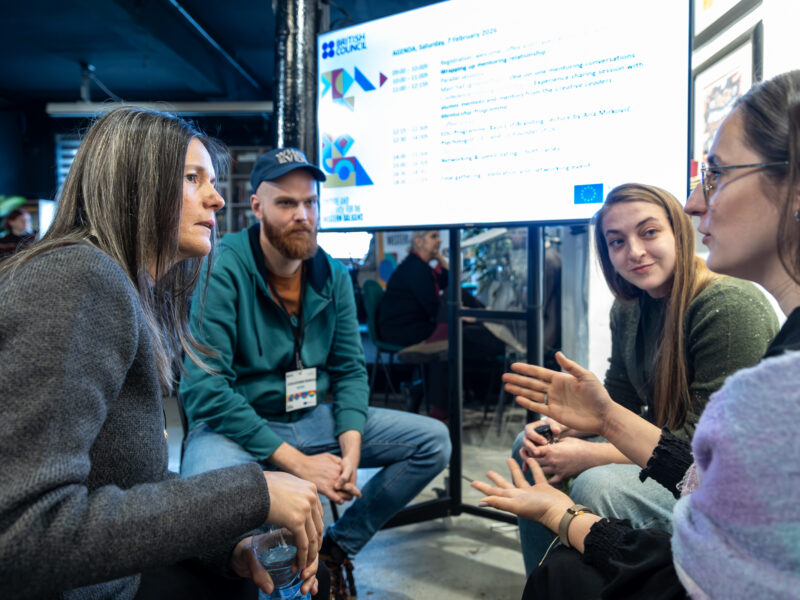
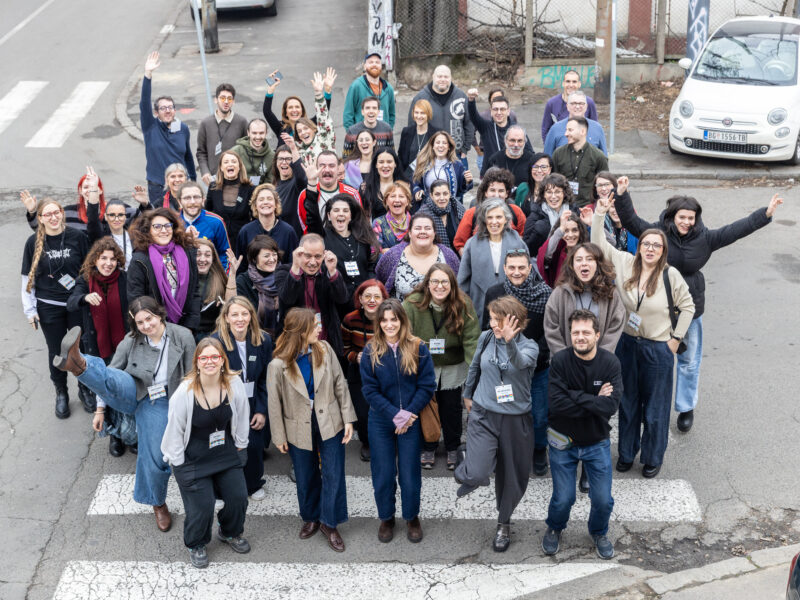
Although working with mentees and mentors from 11 countries across 4 continents initially seemed like a logistical challenge, it quickly became one of the programme’s greatest strengths. The exchange of diverse cultural perspectives, professional contexts, and artistic experiences enriched every mentoring relationship and introduced an additional layer of learning that would not have been possible in a more uniform environment.
Throughout the programme, mentees were encouraged to develop their personal projects and professional ideas — not as a departure from their research work, but as a natural extension of it. The Bridge demonstrated that academic and practical work can meaningfully coexist, strengthening not only individual careers but the broader field of music research, production, and education. This kind of non-academic mentorship also strengthens the academic institutions to which these students belong – it represents a valuable added benefit to existing mechanisms such as formal studies and academic supervision.
Although Creative Mentorship has long emphasised that the success of mentorship should not be measured solely through the completion of projects or new employment, the outcomes of The Bridge speak for themselves. Several mentees achieved concrete, measurable progress:
- One mentee secured a new job in a desired position and relocated abroad.
- One mentee obtained employment with direct support from their mentor during the application, interview, and preparation process.
- One mentee developed a postdoctoral project idea and identified international collaboration opportunities.
- One mentee created a strategic plan for establishing a new organisation.
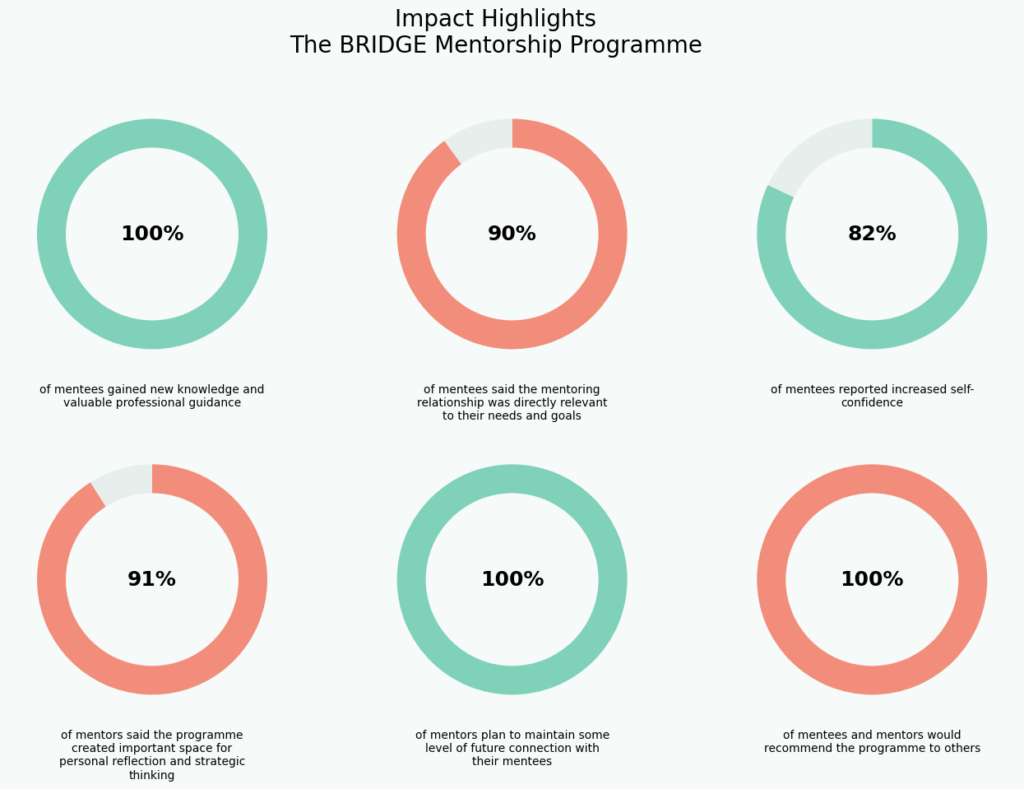
Beyond these achievements, all mentees expressed deep satisfaction with the programme, highlighting newly gained knowledge, increased confidence, and a fresh, empowering perspective on their strengths, potential, and professional direction. Mentors reported similarly meaningful benefits — space for reflection, strategic thinking, and the opportunity to support the next generation of music professionals. This confirms that The Bridge was a true win-win experience for both mentees and mentors.
One-pagers detailing the impact of this programme are available separately for mentees and mentors.
The Bridge Mentorship Programme in Numbers
- Duration: April 2024 — April 2025
- 22 participants forming 11 mentorship pairs from 11 countries across 4 continents
- 81 mentorship meetings (100+ hours of mentoring work)
- 3 main workshops: Kick-off, Mid-term, Wrap-up
- 3 informal group consultations for additional support
- Practical tools, resources, and individual consultations provided by the Creative Mentorship team
Impact Highlights
Why Mentorship Matters
The Bridge Mentorship Programme has shown that non-academic mentorship is not simply an optional support tool — it is an essential element of contemporary education, especially within artistic and research-oriented fields. Mentorship:
- strengthens personal and professional development,
- supports the transition from academia to the professional sector,
- directly contributes to the core goals of the Music4Change project: improving the quality of doctoral music education through innovative, interdisciplinary learning.
Non-academic, structured Mentorship is not an addition — it is a necessity.
The Bridge Mentorship Porogramme has demonstrated, through both qualitative experience and measurable impact, how transformative this form of support can be.
The Creative Mentorship is an international expert in developing, co-creating, and running diverse mentorship programmes tailored to the needs of mentees and projects. Contact us to discuss our potential partnership for your mentorship and capacity-building initiatives, institutions and organizations.
Foto: Unsplash/John Tyson